

When the Wells Run Dry: Living Through Nova Scotia’s Worst Drought on Record | by K Porter | Oct, 2025
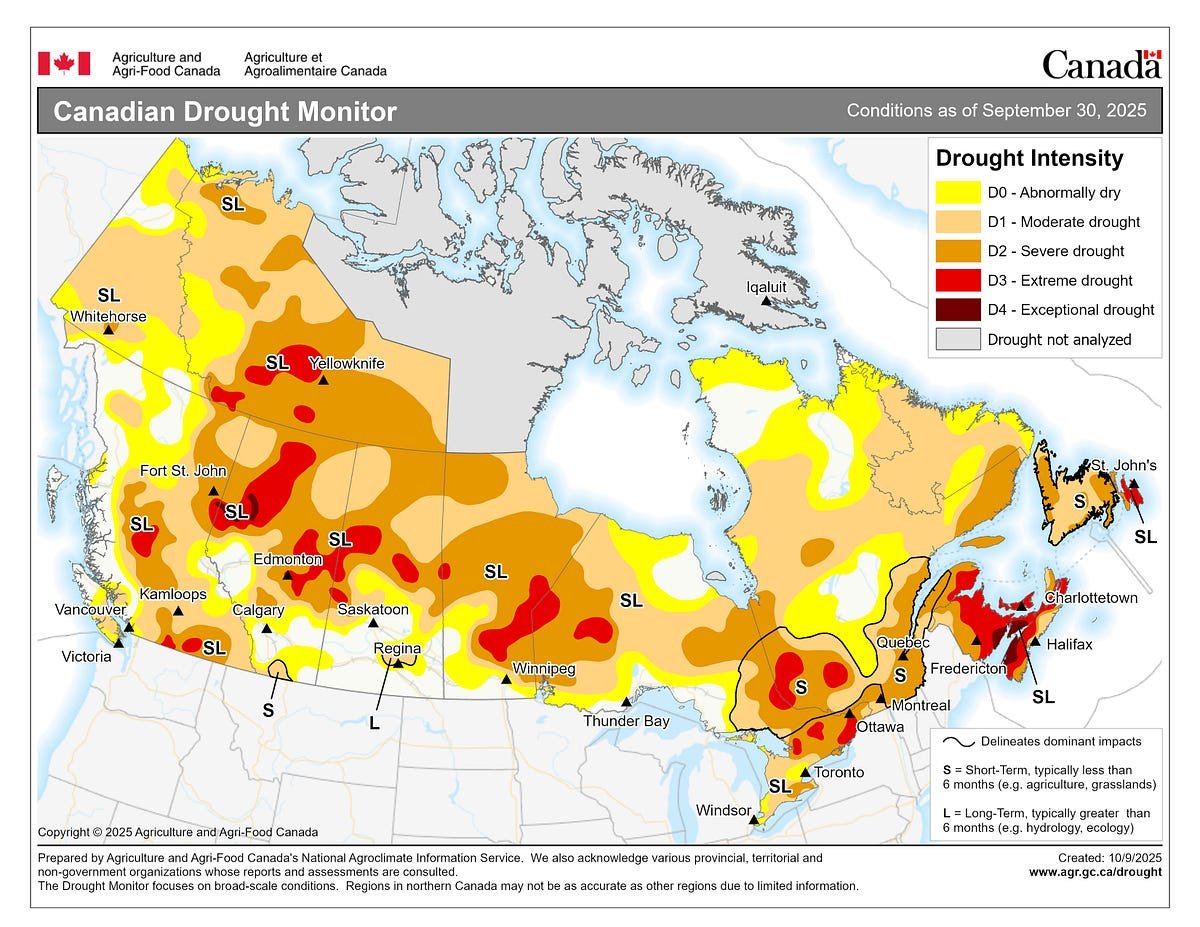
Map courtesy of Agriculture and Agri-Food Canada. It shows widespread drought conditions across the country, with much of Canada, including Nova Scotia, experiencing extreme (D3) and exceptional (D4) drought levels These conditions illustrate the depth of the ongoing water crisis affecting wells, farms, and ecosystems throughout the region and across the country.
This summer and fall, Nova Scotia has quietly slipped into the worst drought in recorded history. In rural communities, where most of us rely on wells, the impact is deeply personal. Everyday, I see my neighbors travelling up to the local spring to collect water. In other parts of NS I hear storis of folks hauling water from brooks, streams, ponds, and lakes, not for crops or livestock, but for the basic needs of human life: washing, drinking, and flushing toilets.
What used to be a simple act , like turning on the tap, has become a daily calculation. For many families, it means driving down gravel roads with 1,000-litre plastic tanks, filling them wherever they can find a sufficient supply, while praying for Rain .
The Winter Ahead
What keeps me awake at night is what’s coming next. With winter closing in and temperatures dropping below freezing, the brooks, ponds, and lakes people have turned to for water will soon be locked in ice. The tanks that store what little we collect are at risk too, when the plastic freezes, it can split or crack, wasting the very resource we’re worked hard to collect. The solutions to keep ice at bay are not simple, using heated wraps, insulated sheds, or constant water circulation, all of which require power, money, or time that many rural Nova Scotians don’t have.
From Flood to Famine in Two Years
It’s hard not to think back just two years ago when the water table was overflowing. In July 2023, some parts of Nova Scotia received three months’ worth of rain in just 24 hours. Communities like Bedford were hit hard, streets turned into rivers, homes were destroyed, infrastructure washed away, and lives were tragically lost. The flooding even made international headlines, with Chinese state media covering the province-wide state of emergency and devastation that followed.¹
Today, those same places are bone-dry. The Sackville river, that flooded into homes and business along the Bedford highway is now reduced to a trickle, something that has the Sackville River Association is very concerned.² On my own property, my pond and brook have been bone dry for months, something I nor the previous owners of the property have ever seen. These swings aren’t random, a report from the Yale School of the Environment in 2019, notes that these swings are result of a phenomenon known as “Climate Whiplash” a symptom a warming climate. More extreme floods, longer droughts, and sharper weather swings are becoming the new normal.³
The Impact on Agriculture
This drought isn’t only affecting households, it’s taking a devastating toll on farms across the province. Many farmers are facing impossible decisions as wells and ponds run dry. Cattle, dairy, and poultry operations depend on thousands of liters of water every day for drinking, washing, and cleaning. Without it, operations simply can’t function. Some producers have had to sell livestock early or even cull animals because there isn’t enough water to sustain them through the season. Wells that have run reliably for generations are failing. Ponds that once supported irrigation and livestock are now cracked mud flats. For many in rural Nova Scotia, it’s not just an environmental crisis , it’s an emotional and financial one, striking at the heart of their livelihood. “It’s getting scary,” said Nova Scotia farmer Mary Hamilton in a recent interview. With pastures drying up and water supplies dwindling, she’s now considering selling part of her herd to get through the season⁴
Denial at the Top
South of the border, the U.S. President continues to deny that climate change exists, even as the evidence piles up: more wildfires, worsening droughts, stronger hurricanes, and more violent tornadoes. Meanwhile, the science could not be clearer.
Recent reports from the World Meteorological Organization (WMO) reveal that global carbon dioxide levels surged by 3.5 parts per million in 2024 , the largest single-year increase on record⁵. Total atmospheric CO₂ has now reached over 423 ppm⁶ , locking in more global warming and amplifying extreme weather events like droughts and floods.⁷
The contrast between scientific consensus and political denial could not be more stark. It’s infuriating and deeply sad to watch world leaders ignore what’s literally happening outside their own windows.
A Personal Reflection
Again the drought has been hitting home, over the past few months, I’ve been helping family members fill their 1,000-litre water tank every few days. I’m fortunate that my own well still holds strong, and I’ve opened my home for family to do laundry and shower. But every time I lower the flashlight into the well to check the level, I feel a flicker of fear. What if this is the week it drops or runs out entirely?
Looking Toward Solutions
Moments like these remind me why I do what I do. Helping farms and families adopt energy-efficient technologies, renewable energy, and sustainable practices is more important than ever. Every efficiency upgrade, every solar panel, every conservation effort adds up. It’s not just about saving money; it’s about safeguarding our future and building the tools we’ll need to adapt to a world defined by extremes.
I am also inspired by a story from 2023 where the Municipality of Barrington, began a pilot project will test a wave-powered desalination system in partnership with Oneka Technologies, aiming to bring drinking water from the sea as wells and ponds dry out.⁸ While there as not been any recent updates on the project , this kind of innovation gives me hope, if local communities are beginning to adopt leading-edge solutions, then we’re not just reacting to change, we’re preparing for it.
Climate change isn’t coming; it’s already here. The question is how we choose to respond, I choose to fight!
Sources
- Xinhua News Agency. Nova Scotia declares state of emergency amid heavy rainfall. (July 23, 2023). Link
- Global News. “Water supply has diminished”: Dry weather and the call to conserve in Halifax. (2024). Link
- Yale E360. Climate Whiplash: Wild Swings in Extreme Weather Are on the Rise. (2024). Link
- MSN Canada. N.S. farmer considers selling some of her livestock due to drought. (2024). Link
- AP News. UN agency says CO₂ levels hit record high last year, causing more extreme weather. (2025). Link
- Live Science. CO₂ levels reach record new high, locking in more global warming. (2025). Link
- Reuters. CO₂ levels hit highest ever recorded, WMO warns of more extreme weather. (2025). Link
- CBC News. After years of drought and wells running dry, this Nova Scotia community is looking to the sea.(2023) Link