
Red Car Girl — What Unemployment Really Does to the Human Mind | by Pınar İkbal Han Polat | Nov, 2025
Two years after graduating from university, I ran into my old classmate Hasan on the street. He had lost weight, his shoulders were slumped, and his eyes carried the quiet exhaustion of a young man fighting too many battles alone. After the usual small talk, he told me he was working temporarily at a private environmental consulting firm and was hoping to find a job that paid slightly better.
I asked him why he wanted to leave — in times like these, wasn’t any stable job precious? But the worry on his face told me there was much more behind his answer.
A Café, Two Teas, and a Heavy Silence
We stopped at a small café with black wrought-iron chairs. As we sat, Hasan hesitated before offering to buy me something — a hesitation that revealed everything. I suggested we simply have tea, already knowing I would pay.
The moment the tea arrived, he confessed what he had been carrying inside: he wasn’t just unhappy at work — he was terrified. He had only been there two months. Before that? Five months at another place… six months somewhere else… a trail of unstable jobs across unrelated sectors. Waiting tables, cleaning toilets, filling forms — whatever temporary work he could find.
He was twenty-five and had never known what it meant to feel secure.
The Invisible Weight Placed on a Young Man
Our situations were not so different, but the expectations placed on us were.
I was a woman living in a culture where not working was seen as moral — even preferable. My father, a retired civil servant, received a small but stable salary, and he gave me a little allowance without hesitation or shame.
Hasan was not so lucky.
His father lived in a village, surviving on whatever income he could earn by selling a small harvest. Hasan could not ask him for help. He was expected to take care of himself — and, culturally, to prove his manhood through financial stability. The burden crushed him.
The Shared Reality No One Talks About
Even so, we shared similar fears:
- Our salaries were uncertain — some months the company would deposit incomplete payments.
- We could not leave our families’ homes because job security simply did not exist.
- Even when we were hungry during the day, we pretended not to be — a simple meal from outside felt like a luxury we couldn’t risk.
- Every night came with the same question: “If I get fired tomorrow, what will I do?”
These thoughts eat at the mind.
They cause insomnia, panic, neck pain, chest tightness, teeth grinding, hopelessness, and above all — the crushing belief that you are failing at life.
Millions live in this psychological state every day.
The Girl in Front of the Red Car
Suddenly, Hasan smiled — the first smile I had seen on his face.
“Pınar,” he said, nodding toward the street, “look at that girl holding flowers. She’s so beautiful. So happy. Right there, in front of the red car… I will never have a girlfriend like her because I don’t have a secure job.”
His words tore through me.
At that moment, I made a decision that shaped the rest of my life:
- Healthy food for everyone.
- Safe living space for everyone.
- Education that teaches us to ‘love your neighbor as yourself.’
These were not dreams — they were the three basic needs that define human psychological stability. And I realized: until these needs are guaranteed, none of us are truly free.
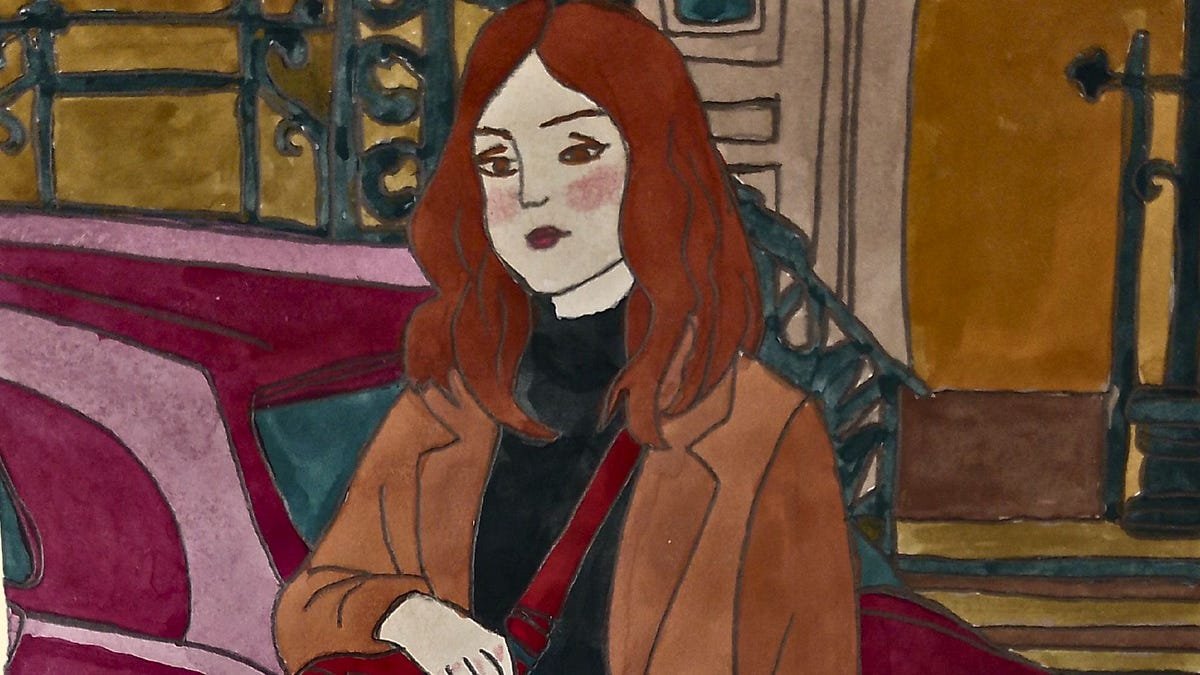
To remember that moment, I created the 13th Illustration:
Red Car Girl — the girl Hasan watched from across the street, symbolizing the unreachable peace every unemployed person feels denied.
The False Promise of “Just Find Another Job”
When you are unemployed or stuck in insecure work, everyone tells you the same thing:
“Find another job.”
But another unstable job is not the solution.
You can work temporarily — of course — but a second shift must begin immediately. A shift that no one pays you for yet:
Supporting the creation of a system that guarantees the three basic needs for all humanity.
The Plan I Will Build One Acre at a Time
To begin this movement, I will create a food forest on one acre of land. Every year, I will expand it. Through watercolor illustrations, YouTube talks, Medium posts, and future videos from the land itself, I will document every step.
It will become the first piece of a system where:
- Healthy food is accessible to all,
- Safe living spaces are built intelligently (possibly with 3D printers or modular structures),
- AI-supported cameras monitor safety rather than control people,
- And a long corridor of interconnected stations teaches the meaning of “love your neighbor as yourself.”
These stations will work like levels in a computer game — perfectly suited for the generation now growing up on screens. Fail a level? You go back. Pass it? You progress.
This corridor will become a living laboratory to reduce human error and rebuild trust through shared responsibility.
When These Three Needs Are Guaranteed, Labels Disappear
If I can access healthy food,
If I have a safe home,
If I live in an environment where people wish for me the same good they wish for themselves…
Then I am safe.
In such a society, words like “jobless,” “broken,” “anxious,” or “unwell” lose all meaning.
Raise Your Voice — Or Build Your Own
If you want these three needs to be guaranteed, amplify my voice.
If you have a better idea, amplify your own voice.
But do not remain silent — not now, not in the age when everything is shifting.
I will begin with a small area, expand it throughout my life, and leave behind a legacy — a foundation upon which humanity can continue its evolution.