Best Organic Cotton Socks – Gurl Gone Green
Socks are one of those everyday essentials we tend to overlook, until the holes become impossible to ignore. But if you’ve ever worn a well-constructed pair, you know how much of a difference a properly fitting, breathable sock can make.
I’ve been slowly swapping out my ill-fitting, polyester-blend socks for high-quality organic cotton options, and the difference has been noticeable. I’m on my feet all day, and I don’t want synthetic fabrics—along with their heat-trapping and moisture-holding properties, against my skin for hours at a time. The sweaty feet by the end of the day were proof enough.
Today, we’re diving into the world of organic cotton socks: why organic cotton matters, what to look for when shopping, and the best brands to consider for your sock needs.
*Affiliate Disclosure: I do have affiliate links in this blog post. If you purchase something from my link, I will receive a small commission from the sale. This comes at no cost to you but is paid by the company. I do not take becoming an affiliate with any company lightly. If I am, it’s because I believe in the company and their product.
*Suzi (Gurl Gone Green) is a participant in the Amazon Services LLC Associates Program, an affiliate advertising program designed to provide a means for sites to earn advertising fees by advertising and linking to amazon.com.
Why Choose Organic Cotton Socks?
Organic cotton socks minimize exposure to harmful chemicals, while also improving comfort and using materials that support your body instead of working against it. From a practical standpoint, organic cotton socks are more breathable and sustainable.
Related Content: Best Organic Cotton Bras
What to Look for in Truly Non-Toxic Socks
1. GOTS-Certified Organic Cotton
GOTS (Global Organic Textile Standard) is a good overall certification to look for. This certification requires organic natural fiber and strict standards on toxic chemicals and dyes and a ban on GMO seeds. However, if you want to make sure you are not exposed to any plastic, check the label for materials used, because GOTS allows up to 5–10% synthetics for trims or stretch.
2. Minimal Synthetic Fibers
Socks that contain mostly natural fibers but have 1-5% synthetic fibers to make them functional are considered minimal synthetic fibers. These minimal synthetic fibers are usually elastane (spandex) or nylon.
Are there any socks with no synthetics?
Although uncommon, there are socks that are free of synthetics.
3. Low-Impact or Undyed Fabrics
Many conventional dyes contain heavy metals, petroleum-based solvents, formaldehyde resins, and azo dyes that release carcinogenic amines.
Undyed fabrics are just that—undyed, while low-impact dyes fall into one of the following categories:
- Fiber-reactive dyes
- Plant-based dyes
- GOTS-approved dye systems
- OEKO-TEX certified dye houses
4. No Antimicrobial or Odor-Control Treatments
Antimicrobial or odor-control treatments use chemicals to kill bacteria. Common antimicrobial agents may include:
- Silver or silver nanoparticles
- Benzalkonium chloride
- Cetylpyridinium chloride
- Alkyl dimethyl ammonium compounds
- Other proprietary biocides
These finishes are applied during manufacturing and can persist through multiple washes.
5. Safe Elastic and Thread
When it comes to elastic, your best option is GOTS-certified natural rubber with 100% organic cotton covering, if that’s not an option, look for OEKO-TEX certified elastane, Bluesign-approved elastane, or elastane that states it has a non-toxic finish. Natural rubber plastic is at the top of the list because as the name implies, it’s made from the sap of the rubber tree. There is no petroleum, PFAS, plastic microfibers, it’s biodegradable and yet it provides good stretch and recovery.
When it comes to thread, GOTS-Certified Organic Cotton Thread is the best, but if that’s not an option, look for TENCEL™ or Lyocell Thread.
6. Ethical and Sustainable Manufacturing
When it comes to organic cotton socks, ethical and sustainable manufacturing means evaluating the entire lifecycle, from cotton field to finished pair, rather than focusing on fiber content alone.
Look for brands that can trace their cotton back to certified organic farms, pay fairly and provide safe work conditions, use low-impact processing and dyeing, and avoid unnecessary synthetics and chemical finishes.
Certifications that can help enforce these standards are:
- GOTS – Covers organic fiber content, chemical restrictions, and social criteria
- OEKO-TEX (select standards) – Screens finished products for harmful substances
Related Content: Best Organic Cotton Underwear (For Women)
Materials to Avoid In Socks
Best Organic Cotton Socks
Mate The Label
Best Organic Cotton Socks for Everyday Wear
Size Range: Women S/M, M/L
Price: $48 (3 pack) – $68 (5 pack)
Review
These were one of the first organic cotton socks that came on my radar a couple years ago. I hadn’t found a lot of organic cotton socks options that were crew socks until Mate The Label. These socks are so good! They’re not a true white but more of an ivory/cream color. They are a tad thicker compared to other brands I tried. I like the thickness and the weight of them. They have held up so well over these past couple of years. They are great for working out or just wearing out and about. They aren’t too tight around my calves either. All around such a great organic cotton sock option that I would recommend again and again!
Maggie’s Organic
Best Overall Organic Cotton Socks
Size Range: Unisex M, L, XL
Price: $8.50 – $32 (3 pack)
Review
These were a newer organic cotton sock option for me. I was pleasantly surprised how much I loved them! Their Classic Crew Sock is definitely the closest sock to an all cotton organic sock. Most socks have to have some sort or nylon or elastane to keep them from just falling down completely. These are made with 98% cotton, 1% nylon and 1% elastane. I can tell wearing them, that there isn’t any stretch or tightness compared to other socks. They are looser and more room to breathe. I personally like that about them. I don’t like when socks have a really tight binding around the calf area and leave a mark- I want all the blood flow to my feet! But wanted to note that.
Use code GONEGREEN15 to save 15% off your purchase!
Allwear
Best Organic Cotton Athletic Socks, Best Organic Cotton Socks For Men
Size Range: Unisex S, M, L
Price: $12 – $36 (5 pack)
Review
I thought I was going to really like these but I actually didn’t as much. The main reason is they were so tight on my calves! By the end of the day when I took them off, there was an indention on my calves- definitely not what I want. If you have very small calves, these might be a great option, but they weren’t my favorite for that reason.
Q for Quinn
Best Organic Socks for Comfort, Best Organic Cotton Socks For Kids
Size Range: Children 3-12M, 1-2Y, 2-4Y, 4-6Y, 7-11Y, Adult S, L
Price: $17 – $90 (5 pack)
Review
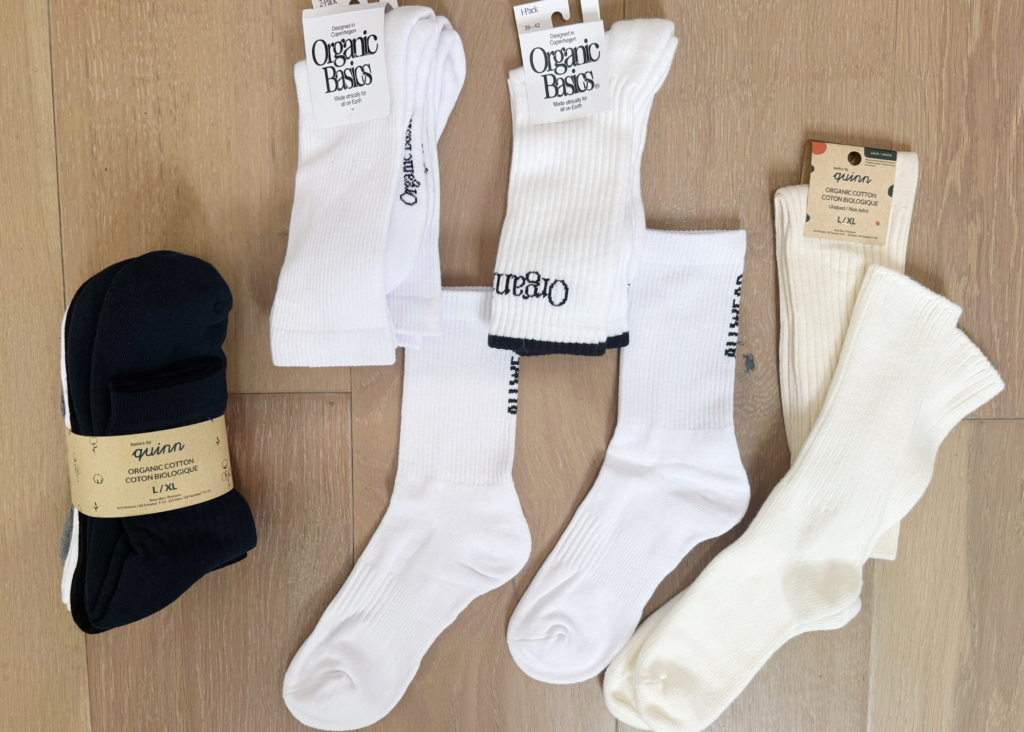
This was a new brand for me to try. I have heard about Q for Quinn but hadn’t tried any of their products until now. They have some options when it comes to their organic cotton socks. I tried their Organic Cotton Quarter Pacers Sock and really was so impressed. It’s made with 97% cotton and 3% elastane. I liked how the sock wasn’t super thick, but the footing was cushioned and a bit thicker. Nice for keeping feet warm but nice for everyday wear. They weren’t tight at all along my ankles. Felt so good! I also tried their Adult Ribbed Cotton Socks and didn’t love them as much. They’re more of a trouser sock, but even longer- think knee high. They aren’t something I would wear typically, so maybe that’s the issue. The sock itself felt good and is lighter weight overall. I don’t have a need for knee highs or trouser type socks, but if you do, these might be a good option!
Pact
Best Organic Cotton Athletic Socks, Best Organic Cotton Socks For Men
Size Range: Women 6 – 10, Men 9 – 13
Price: $14-$24
Review
These were the very first organic sock I tried years ago. I love their ankle socks! They stay on my foot and are great for a no show sock. I’ve worked out with them, run in them- done all the things and they feel good. My only complaint is I have had several holes in them. I really wore them all the time for a couple years, so it makes sense that they would eventually wear down, however, I have worn my Mate The Label ones to the ground as well and I haven’t had any holes. Just wanted to note that. These are also a bit more budget friendly compared to other organic cotton socks.
Organic Basics
Best Organic Socks for Everyday Wear
Size Range: Unisex 5-10, 10-13
Price: $16 – $48 (6 pack)
Review
I have tried Organic Basics socks in the past and have found they are a great quality overall. I really like their Core Logo Crew Socks. They are more fitted, but not crazy tight like some of the others I mentioned. They have held up so well and have stayed up while running or working out. These do have more nylon in them, so not as much cotton if that is a concern for you.
Use code SUZIXOB10 to save 10% off your purchase!
Vintage Amazon Cotton Socks
Best Organic Socks for Everyday Wear
Size Range: Unisex 5-10, 10-13
Price: $24.99 (4 pack)
Review
So these are not organic, but I had to include them because they’re so good! While I think organic is ideal, I’ve found they can be pricier and as with everything when it comes to natural living there are levels. I think finding a mostly cotton sock option is also a win! These are from Amazon and a great budget friendly option. I have turned many converts on to them. They are a crew sock and aren’t too tight but do have some stretch. I have bought them for my daughter, my sisters have them and we are all fans! If you’re not wanting to break the bank and are ok with not having organic cotton, this might be a great option for you!
Frequently Asked Questions About Organic Cotton Socks
1. Are organic cotton socks completely plastic-free?
Just because socks are made with organic cotton doesn’t mean they are plastic-free. Plastic can show up as elastane/spandex for stretch or polyester in the cuff or reinforced heels or even in the thread used. A sock must contain 100% natural fibers and disclose any elastic sources to be completely plastic-free.
2. Do organic cotton socks stretch out over time?
Organic cotton socks can stretch out over time because they do not have any elasticity. However, if they are well-made and have some clearly disclosed stretch fibers then their stretch will last longer.
3. How do you wash organic cotton socks?
Wash in cold water.
Use a gentle detergent. Check out my favorite non toxic laundry detergents here!
Air dry or tumble dry on low.
4. Does anyone make 100% cotton socks?
Yes, 100% cotton socks exist, but their fit, stretch, and even durability may be less than desirable.
Final Thoughts: Are organic cotton socks really necessary?
Would organic cotton socks be the very first clothing item I’d invest in? No. But do they make my top 10? Absolutely.
In my opinion, any tight-fitting fabrics that sit against your skin all day are worth swapping for natural fibers. Breathable cotton socks are a simple way to show a little gratitude to your feet—for carrying you through every step of the day.
Do you have a favorite organic cotton sock brand that I missed? Share it below!
If you liked this post, check out these past posts: