
Are there any animals other than humans that “repay kindness”? | by Oliver Thomas | Apr, 2026
This happened when I was in elementary school. I once found a crow that had fallen from its nest in a tree and raised it. I named it Kuro (literally “black”). It was a really tiny chick, so I remember working hard to raise it by making a liquid food similar to what parakeet chicks eat.
As he grew older, we could no longer keep him in a cage, so we started letting him fly freely outside. However, Kuro, who thought he was a human, would pester us by swooping down from above, as if to say, “Why aren’t you flying?” From the neighbors’ perspective, it seemed quite suspicious to see a crow attacking a person (I later learned this from my parents). It was the first time I had ever kept a flying animal that was so tame, so taking him for walks to nearby parks with large hills and watching him fly was a daily joy. As is well known, crows are very intelligent and understood simple words like “Let’s go home” and “It’s time for food.”
The turning point came when he encountered another crow (or perhaps its parent?). Kuro, who had never seen a crow in person before and thought he was human, was deeply shocked to see a fellow crow that looked just like him (he was intelligent enough to look in a mirror and recognize himself as such) and could fly. He couldn’t leave the house for about a week (imagine him shivering under a blanket, pleading, “What’s that black thing! Am I not human after all!?”). Moreover, during that time, the other crow (parent? parent?) kept coming to the front of the house and cawing loudly, as if urging him to come out.
Kuro started going outside again, and his daily walks to the nearby park resumed. However, he began going out with other crows once or twice a week, and after a few months, he was only coming home about once a week. I remember trying to convince myself that it was inevitable as he was returning to nature. But one time, he came back and stayed at home for about a week. I wondered if he would stay permanently, but after a week, his companions came to pick him up again, and Kuro left cawing. Looking back now, I wonder if it was his last act of filial piety before getting married? After that, he never came back into the house.
Well, Kuro had completely transformed into a crow and left home, but he would still dutifully come back to the tree in our yard every few months. When he did, he would bring me nuts or some kind of meat in his beak. To a human, it was like, “What is this…?” but to me, I still think it was Kuro’s way of repaying my kindness. There doesn’t seem to be any precise research on the lifespan of crows, but they live for at least 15 years, and legend says they can live for 100 years (they’re practically mythical creatures!). Crows are generally disliked, but whenever I see a crow, I remember Kuro, and even now, 30 years later, I can’t help but talk to them (lol).
By the way, I couldn’t tell the difference between male and female. Even after searching online, it seems difficult to distinguish between male and female crows. In my mind, I always pictured them as males…
Two birds came to pick me up first. So, as a child, I thought, “Mommy and Daddy have come!” But now that I think about it, I’m not sure if egg-laying birds have any way of recognizing their offspring once they’ve been separated. I’ve heard they have a strong sense of community, so maybe it was one of their neighbors who came to pick me up.
I wrote that they continued to visit regularly even after being released back into the wild, but at first it was just one of them coming almost every week, and then later they started coming together to the power lines around my house. I was happy, thinking, “He’s brought a mate with him!” However, the other one wouldn’t come close, and when Kuro played with me for a bit and went back to where the other one was, it looked like he was being scolded. Looking back now, it was like his mate was scolding him for leaving him to play with a human! (laughs) After that, the intervals between their visits gradually lengthened until it was only once every few months. I was lonely back then, but thinking that he was probably bossed around by his mate makes me smile a little.
I will add some points about the pros and cons of keeping crows as pets.
Pros: They are indeed intelligent. Generally, I’ve heard that cats and dogs are at the same level as a 4-year-old child (I’ve owned both), but crows seem to be around 6 years old. I was 8 or 9 at the time, but I remember Kuro occasionally lecturing me, saying things like, “It’s about time we went home, you know,” or “There’s a better place over here, isn’t there?” Sometimes I couldn’t tell who the older brother was. When I spoke to him, he would listen intently, looking me in the eye. I don’t know if he understood everything, but I felt that he at least understood that I wanted to say something or communicate something.
Cons: The droppings are typical of birds. They basically don’t choose a place or time to defecate. I’ve had rooms covered in droppings, and I’ve even had them on my head. This is just a common characteristic of birds, so there’s nothing I can do about it.
A reunion after more than 30 years?
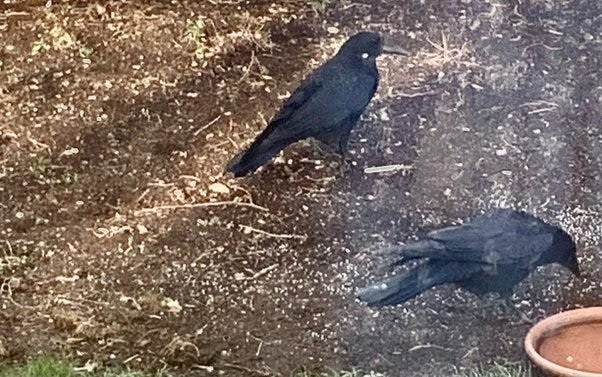
The other day, when I went back to my parents’ house for the first time in two years, I found two crows in the garden! (laughs) It seems they started coming regularly after I made a bird table. There was a big crow and a small crow, and they seemed to be a pair. The big crow was very friendly and would peck at the window to ask for food if there wasn’t any on the bird table. This happened more than 30 years ago, but considering the lifespan of crows, I can’t help but wonder if it’s not entirely impossible. (The one in the foreground is a little bigger and will come close even if I go outside. Probably a black crow! The one in the back will run up to the roof when it sees me, so it’s probably the mate. I hope they get along well so the mate doesn’t dislike them! (person))